
EdmundusRex just uploaded With A Song In My Heart, performed by Jack Hylton's Orchestra, and he includes a great writeup: "Jack Hylton (July 2,1895 - Jan.29,1965) was a British band leader and impresario. He was born in Bolton and he came from a working class background. As a boy, would accompany his father on the piano when he sang in clubs. He also performed at an early age as the "Singing Mill-Boy" and as a relief pianist for various bands.
His early career was as a relief pianist in the 400 club and with the Stroud Haxton Band. After the first world war he went on to play with the Queen's Dance Orchestra where he wrote arrangements of popular songs and had them recorded under the label 'Directed by Jack Hylton'. He went on from here to form his own band.
The band started recording under Jack Hylton's name in 1923. Jack became a respected band leader and was in great demand, so much so that he had to provide bands simultaneously in various locations under his own name. In the 1920s (Babyin' You 1926) the band developed into an orchestra and had a busy schedule. It toured America and Europe and continued until the 1940s when the orchestra disbanded due to members being called up for war service.
Jack was also director of the DECCA record label. All Of Me (Decca Recording).
At this point Jack Hylton's career was already moving towards that of an impresario discovering new stars and managing radio, film and theatre productions from Ballets to Circuses. His productions dominated the London theatres.
Some of the stars he managed, appeared in his productions or discovered were Shirley Bassey, Maurice Chevalier, Ernie Wise, Eric Morecambe, Arthur Askey, the Crazy Gang, George Formby, Diana Dors, Thora Hird, Liberace, Noel Gordon, Sid James, Rosalinda Neri to name but a few.
Jack Hylton and his Orchestra - With A Song In My Heart (1930)"
Well, that information is certainly interesting. If you have seen the James Bond movie, Goldfinger, you have heard Shirley Bassey, and I never would have guessed that she got her start with someone who was a bandleader starting in the 1920's. Maurice Chevalier has always impressed me. He always comes across in his songs as being a very happy person, but he was a French soldier who fought at Verdun, was wounded, and was a prisoner of war for a couple years. It's a good thing he never heard of PTSD, or he might not have made all those great recordings and movies. Here are a couple of his, from RReady555.
Sunday, September 23, 2012

Saturday, September 22, 2012
I-What?
The latest mememe going around the blogs is What's On Your I-Pod? That's one thing I haven't jumped into, although I do have a bunch of these copied into the computers that I use on a daily basis.

I'm just a little analog.
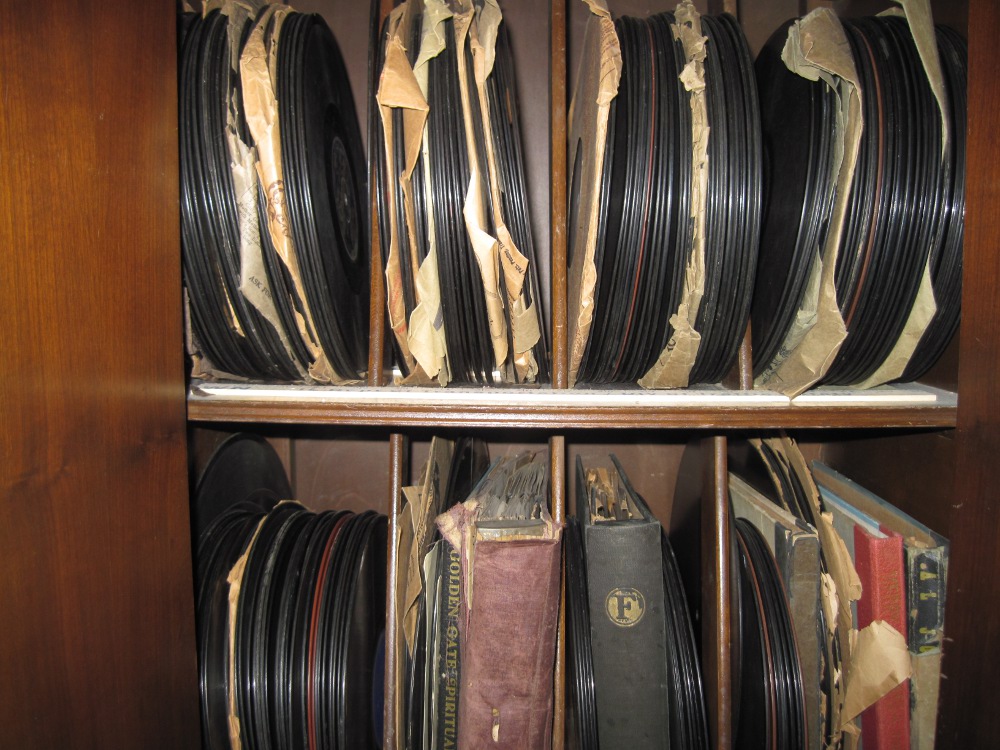
I'm just a little analog.
September e-Postal; This Weekend or Next!
We are over halfway through September already, and you just have two weekends to work in a range trip to shoot the Mr. Completely e-Postal Contest for September 2012. It's an easy contest to make a good score, but difficult to shoot a perfect score. It's all about having fun while you get in some much needed shooting practice, so CLICK HERE for the rules and the target, and head to the range with family and friends.


Can you shoot five doubles with a .22?
Weekend Steam: Who's That Knocking?
The Peerless engine was on the Baker Fan at Pinckneyville in August. Something has a little slack in the engine and is making a pretty good knock. I was guessing that it was in the crosshead, and you can see one of the engineers go up close for a listen.
Engine noises have always worried me, and I listen for things constantly when an engine is running. My 1923 Model T had a bad throw on the number three cylinder, and I became skilled at dropping the pan, and adjusting the slack out of the rod bearing. (Loose Model T rods make a very loud clatter, and you had better stay throttled down so you don't pound the babbit out of the bearing.) Dad located a good crank and we pulled the engine out of the old truck. Dad had that engine apart and back together in one day while I was at school, so he would have made a pretty good Model T mechanic. He taught me to take it easy on machines, and to not be tearing them up through abuse, and I had to be retrained a bit when I was working an oil field job. I was taking some tools into a cable rig on a muddy lease, and couldn't get the two wheel drive Chevy back to the rig. The driller took the wheel and told me, "You've got to build a fire in that son of a .....!" And he did, with the motor revved wide open, mud flying, and smoke boiling off the tires, he got that truck to the back of his rig. We off-loaded the tools and he drove it back out again, just as loud and wild. It was a good demonstration, and I always got to the rigs after that, although I don't know how the trucks held together.
Getting back to the steam engine, the rod bearing on this engine is adjustable, but the crosshead bearing is not. That is why I think that the crosshead is doing the clicking. The main bearings on the crankshaft would project a deeper and less definite note. My guess is that the Peerless is half torn down between shows now, and some newly fitted parts will have it running quietly in October.
Thursday, September 20, 2012
Words of Encouragement For Patty

Physical therapy is hard, and trying to make an arm relearn how to work is not just terribly difficult, it's exasperating. We are all pulling for you, Pat! Here is a good story from Ernie Pyle that should encourage you a bit.
"For nearly twenty years I had rolled my own cigarettes. I did this because (1) I liked them better than ready-mades, and (2) people, especially in the East, admired this strange ability, and the distinction made me somewhat more of a drawing-room attraction than I would have been otherwise. My friends all knew that I could roll a cigarette in the dark, or in the wind, or behind my back, or riding a horse, or with my eyes shut. But that wasn't enough. What I really wanted to do was roll 'em with one hand. I'd rather roll a cigarette with one hand than be president. In the West I was always watching for a cowboy who might teach me to roll 'em with one hand. But I'd never seen a cowboy rolling a cigarette with one hand. Most of them couldn't even do it with two hands.
One night, sitting in one of the Ketchum "clubs" watching a 21 game, I found my man. He wasn't a cowboy; he was just a nice-looking fellow in overalls, and he had only one arm. And I sat speechless as he laid the paper on a crease in his pants, filled it with tobacco, and twirled as neat a cigarette as you ever saw. So I walked over to him and said, "Would you step outside a minute? I want to talk to you." In the East you'd probably get hit if you said that to a stranger, but this wasn't the East, so the young man said, "I certainly will," and followed me out.
"I saw you rolling that cigarette," I said. "I've always wanted to roll them with one hand, and I thought maybe you could teach me."
"Well, " he said, "I don't know whether I can teach you, but I'll show you how I do it."
So I sat on the bumper of a car, and he squatted on the sidewalk in front of me and pulled out his tobacco sack. "To begin with," he said, "you crease the paper way up high, like this."
I said, "Oh, I never thought of that. How long ago did you lose your arm?"
He said, "Eight years ago. Then you slide it down along your second and third fingers, and then joggle it with your thumb till the tobacco's even."
I said, "Did you roll your cigarettes before you lost your arm?"
He said, "No, I never smoked at all till after I'd lost my arm. When you get it all even, then you slip your first finger over across it like this, and then press down hard."
I said, "That's where I get stuck. My finger's too stiff. How did you lose your arm?"
He said, "A runaway team of horses."
I said, "They must have broken your arm a dozen times, to have to have it amputated."
He said, "It got caught between the wagon tongue and the singletree and they just beat it to pieces. There wasn't hardly anything left of it."
I said, "Are you working here in Ketchum?"
He said, "I'm not doing anything right now. Last year I worked up at the construction job carrying water. But they won't give me anything this year. A big outfit like that don't give a damn for one man."
I said, "Here's my trouble. I never can keep the edge of the paper turned under."
He said, "That's the hard part. You have to press real hard. It's easier with that ribbed paper you get with cans of Prince Albert. It takes a lot of practice."
I said, "I'd think there'd be lots of jobs you could do with one arm as well as two."
He said, "Sure there is, but they won't give me nothing on account of it."
I said, "Are you gonna stay around here if you can't find anything?"
He said, "No, I'll go down below and get a little work diggin' spuds. After that I don't know what I'll do. I'd like to go over close to Portland and rent a farm, but it takes a little money and I can't make any money."
I said, "I did pretty good on the first one, but this second one keeps slipping." Then I said, "Are they just indifferent, or have thay got something against you?"
He said, "It really looks like they've got something against me. I can't get on nowhere. Sometimes I get so blue and disgusted I feel like gettin' me a gun and just go shootin' up and down the street. You're gettin' onto it now, but it takes practice."
I said, "Will you be around tomorrow night?" He said, "Sure, I''ll be along here somewhere." I said, "All right, I'll practice and let you know tomorrow how I get along."
I went back to the hotel and sat over a wastebasket and practiced. I had to keep my right hand in my pocket, so it wouldn't always be jumping up to help my left hand. And as I sat there it came to me that rolling a cigarette with one hand was a very trivial thing in the awful pilgrimage we were all making across the hard years to the goal of final sleep--just a little whim that didn't have to be humored at all. And yet I sat there and tried and tried and tried, till I got so damn mad and disgusted I felt like gettin' me a gun and shootin' at the floor or something." From: Home Country by Ernie Pyle; William Sloane Associates, New York, 1947.
And if you feel like shooting up and down the street, I bet we could help you arrange that!
Wednesday, September 19, 2012
The Last Day Lilies Of Summer?

The day lily gardens were pretty quiet during the depths of drought this summer, but now that we have had a few good rain events they are showing just a little color again. The roses are running wild since they have had a good soaking, and we will have color for a few more weeks.


Ruger Finishes One Series (Carrying Concealed), and Begins Another; Handgun Hunting!
Lori Petoske and Il Ling New finish up their concealed carry series in the first video, and then Ruger treats us to an entirely new topic in the second one. This is a great set of videos, Lori, Be sure to tell Mr. Fifer that we really like what you are doing on YouTube!
Nearly forty years ago I read an article about the Thompson Center Contender. The article told about TC's .44 Magnum barrel, a removable choke, and TC's Hot Shot cartridges which were supposed to be equivalent to .410 shot shells. I lusted after one of these, and bought one in a gun shop in Pikeville, Kentucky. The Hot Shot cartridges might have been OK for using on rabbits and Midwestern fencerow squirrels, but I bagged only one Appalachian gray squirrel to figure out that this was not a good combination for little squirrels in tall trees. I popped a gray that was way up in a beech tree, which anchored him to a limb, and then I used over half the box of .44 shot shells to make him fall. I had to finish him off after he hit the ground. That .44 barrel was a light 10" octagon barrel, and I also learned that factory 240 grain .44 Magnum rounds delivered brutal punishment to the shooter. That was one reason I learned to load my own ammo.
I soon bought a 10" octagon .222 Remington barrel for the Contender frame, and scoped it with a 2.5 X Bushnell Phantom. This was a great combination, and I still shoot it today. The .222 barrel accounted for a lot of groundhogs in Kentucky, and it has dispatched several skunks down on the farm. The Contender also has a .22 LR barrel with a scope, and it is good for squirrels, possums, and coons.
My current favorite for dispatching errant wildlife around the homestead is a Ruger Mk III Target model, with a red dot scope on top. It does brain shots quite well on possums, which is no mean feat given the small brain in a possum's skull.
There has been lots of discussion about the suitability of the .357 for bagging deer over the years. Out of a rifle, there is no question that the .357 will do the job on deer sized game, but many people hesitate to recommend it for deer. It will shoot all the way through a deer at 100 yards when launched by a pistol, so I look at it more from a standpoint of the accuracy that the firearm and hunter can deliver while hunting. If I decide to go hunting for deer with a pistol, I would take my .44 Redhawk rather than my .357 Blackhawk because of the longer sighting radius, and the tighter groups I shoot with the larger gun. The bigger hole made by the .44 is a bonus, but would not be necessary if I keep my marksmanship limitations in mind.
Anyhow, watch the intro to this new Ruger series, and stay tuned here for the next video.
 BONUS!!! Actual groundhog bagged with the Thompson Center .222! Long, Long time ago.
Nearly forty years ago I read an article about the Thompson Center Contender. The article told about TC's .44 Magnum barrel, a removable choke, and TC's Hot Shot cartridges which were supposed to be equivalent to .410 shot shells. I lusted after one of these, and bought one in a gun shop in Pikeville, Kentucky. The Hot Shot cartridges might have been OK for using on rabbits and Midwestern fencerow squirrels, but I bagged only one Appalachian gray squirrel to figure out that this was not a good combination for little squirrels in tall trees. I popped a gray that was way up in a beech tree, which anchored him to a limb, and then I used over half the box of .44 shot shells to make him fall. I had to finish him off after he hit the ground. That .44 barrel was a light 10" octagon barrel, and I also learned that factory 240 grain .44 Magnum rounds delivered brutal punishment to the shooter. That was one reason I learned to load my own ammo.
I soon bought a 10" octagon .222 Remington barrel for the Contender frame, and scoped it with a 2.5 X Bushnell Phantom. This was a great combination, and I still shoot it today. The .222 barrel accounted for a lot of groundhogs in Kentucky, and it has dispatched several skunks down on the farm. The Contender also has a .22 LR barrel with a scope, and it is good for squirrels, possums, and coons.
My current favorite for dispatching errant wildlife around the homestead is a Ruger Mk III Target model, with a red dot scope on top. It does brain shots quite well on possums, which is no mean feat given the small brain in a possum's skull.
There has been lots of discussion about the suitability of the .357 for bagging deer over the years. Out of a rifle, there is no question that the .357 will do the job on deer sized game, but many people hesitate to recommend it for deer. It will shoot all the way through a deer at 100 yards when launched by a pistol, so I look at it more from a standpoint of the accuracy that the firearm and hunter can deliver while hunting. If I decide to go hunting for deer with a pistol, I would take my .44 Redhawk rather than my .357 Blackhawk because of the longer sighting radius, and the tighter groups I shoot with the larger gun. The bigger hole made by the .44 is a bonus, but would not be necessary if I keep my marksmanship limitations in mind.
Anyhow, watch the intro to this new Ruger series, and stay tuned here for the next video.

Tuesday, September 18, 2012
My Little Brother Is A Real Jewel

Back on September 5, a storm blew a bird nest out of the tree in front of my brothers jewelry shop, along with two baby doves. Doves don't build substantial nests, and this particular nest was an old robin nest that the parents were using. Chester didn't want them to become cat bait, so he tied a cardboard box in the tree and deposited the babies in it, along with a little padding. The parents soon found them and moved right in.

The babies have fledged now, and here you can see them hiding behind the air conditioner compressor right after Mama kicked them out. Well, Chester, that cardboard box won't make it through the winter, so now you're going to have to build a new dove nest for next spring. No good deed goes unpunished.
Photo Credit: Chester
Monday, September 17, 2012
Mechanical Masterpieces
Bob Suhre goes out to his shop every day to machine parts for his mechanical masterpieces. He says that he makes a new engine from start to finish in about one year. Bob was showing his masterpieces at the American Thresherman Show in Pinckneyville, Illinois.
Sunday, September 16, 2012

Subscribe to:
Posts (Atom)


