
Eric Janssen posted this video on his Facebook page. The video is about 35 years old, and I suspect that there are very few little barges making a living this way today. Eric's barge (Valer) was built in the 1920's and has the engine that was installed during the 1930's. His cargo hold serves as an artist studio. He motors about the waterways of Holland with his Schipperke, Saartje, and he is famous among fans of the little black barge dogs.
Sunday, September 16, 2018

Saturday, September 15, 2018
Feeling Blessed
A week ago we had eight inches of rain from Tropical Storm Gordon. There are many around us that lost soybeans from flooding, but our farmer was lucky and so were we. Shelton Creek shoots across a forty that belongs to our farmer, and then it goes across us during flood events. We planted a patch of cypress trees many years ago to kill the velocity and to spread the flow out, and that little patch of trees makes a big difference. It saves soil on a regular basis, and this time it saved some corn. The flood came on Saturday, and on Friday (Yesterday) he was picking our corn. Today he did his field. No channels cut and no corn down! Farmers traditionally don't have a good relationship with trees, but they can work wonders.
Anyhow, here comes the corn, and the combine after the shelling was done.

This is our little miracle worker. Birds love it, too, and deer have been known to hide in it from road hunters.
Anyhow, here comes the corn, and the combine after the shelling was done.

This is our little miracle worker. Birds love it, too, and deer have been known to hide in it from road hunters.
Friday, September 14, 2018
Weekend Steam: South African Steam
Merle is finding some far flung engines for us. I had no clue that an engine like this is running in South Africa. Click it over to YouTube to read the description. This may have been the final run. Thank You Merle!
Wednesday, September 12, 2018
FFA Forestry Sectional Contest
Saturday we had torrential rain, Sunday was cloudy and damp, but running off, and Monday was glorious. We had great field conditions for the students and kept them busy all afternoon. We set up the Compass and Pacing course first thing, then Timber Measurement, Tree ID, Equipment ID, and Silviculture. The students also had to take a general knowledge test and a test on map interpretation. It is a real workout for the kids and a few always excel. Everyone learns, and I bend the rules and coach the ones that don't have a clue what they are doing. That way they learn a bit and they may do well next year. Olney took first, and Fairfield was second. Olney will be going to the state contest at Carbondale on Saturday. Here are a few photos of the activities.

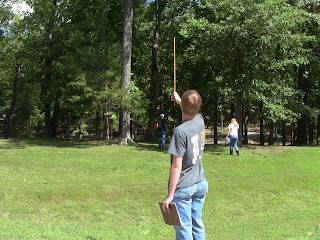


Bonus measurement info that I provide to students, or anyone else who needs to measure tree height:
Measure Log Length With Any Straight Stick


Bonus measurement info that I provide to students, or anyone else who needs to measure tree height:
Measure Log Length With Any Straight Stick
Biltmore sticks are usually set up for a 25” reach on the
tree diameter scale and the Merrit Hypsometer, and many of us do not have a 25”
reach. Using the Merrit Hypsometer
requires that you pace out one chain (66 feet) from the tree, and many of the students
I see do not understand pacing, so they throw a lot of error into the
equation. There is an alternate method
that lessens the errors, but the student must still concentrate on pacing
accurately and keeping good form with a stick.
Much of the upland timber we work in will run from 1 ½ to 2 ½
logs in length. Instead of 66 feet, pace
out 32 feet (2 logs) from the tree and turn around. Your eye is now 32 feet from
the tree. Roll your head back and keep
it motionless while measuring. Extend
the hand holding your stick so it is up to eye level. Bring the top end of the stick back with your
other hand so the stick comes to the corner of your eye. Raise the stick to vertical position, roll
your eye to the stump level of the tree and lower your hand with the stick so
the top of your hand is in line with the stump (Approx, 1 foot from the ground
or less, usually). Hold your head motionless and roll your eye up to the top of
the stick. It will be lined up to show
you 32 feet up on the tree, or 2 logs.
If your cutoff point is no more than 8 feet above that, it is a 2 log
tree. If the cutoff point is no more
than 8 feet below it, you have a 1 ½ log tree.
Because you often will have a 2 log tree, you can see what ½ of that is
and add it to the top of your stick in your head and see if you have a 3 log
tree. If the timber is running taller
than a 2 log average, make your distance 40 (2 ½ logs) or 48 (3 logs).
This method saves a great deal of time in pacing and the 25”
reach of the stick is irrelevant. Check
your pace frequently so you can nail that distance and you will do a good job
of measuring the merchantable height.
Check your diameter measurements with your Biltmore Stick against a Diameter Tape so you will know how
your stick actually measures for you.
Bonus Info: You can also measure very close to the exact
height of vertical objects with a
stick. Holding your stick vertically
with your head back, move in or out from your object until the stick matches up
with the top or the cutoff point. Pace
in to your tree, wall, smokestack, or whatever you are measuring. Now you know the height. This method is also valuable to see if a tree
will strike an object that you don’t want to strike, such as a power line.
Stand at the power line and set up your stick. If the object (tree, silo, smokestack) is
standing taller than your stick, it will hit you. So Easy it should not be legal.
PS: I just heard from Olney. They took first place at the Monticello Sectional and their five team members were all in the top ten.
PS: I just heard from Olney. They took first place at the Monticello Sectional and their five team members were all in the top ten.
Tuesday, September 11, 2018
Ruger's Auction To Benefit The Light Foundation

Ruger is offering a Deluxe Sporter 10/22 this week with a 22 inch barrel. Most 10/22s are made with 18 inch barrels, and some are 16. The 22 inchers are nice for squirrel hunting with standard velocity ammo because they are much quieter than the shorter barreled models. This particular rifle was made in 2001. It will sell mid-day, September 12, 2018. Click Here to read the description and to place your bid. $531
Monday, September 10, 2018
Tuesday Torque: Fascinating To Watch
Hot air engines have been around for a long time and I still can't get my mind around the inner workings. They are quiet, and have a history of working in remote places where fuel supplies were not a sure thing. Build a fire out of whatever and it will spin. Maybe not a lot of torque, but a lot of action.
Sunday, September 9, 2018
Whatsoever Your Hand Finds To Do, ...
...Do It With Your Might!
Back To The Old Grind! Even If You Are Just Having A Good Time!
Back To The Old Grind! Even If You Are Just Having A Good Time!
Flooded Gravel Challenge
Are you up to this challenge? You must know your roads and the locations of drainages and culverts to get around in the country during a deluge. I have seen vehicles swept into fields and also stuck in washed out culverts. Test carefully, do not go over your hubs. Do not be in a hurry. Tomorrow will get here if you don't screw up.
Go Around Or Wait; Don't Drown Yourself Or Your Vehicle
The Gordon system really hosed us, and taking care of the pets at both houses was a challenge. Torrential rain was coming down on the way over, and on the way back, making for bad visibility. I took the long way around, and still had to make an unplanned detour for deep water in the road. The trip over (normally 6 1/2 miles) took an hour. Coming back took longer, plus a wait for more than an hour while I waited for the water to drop at this culvert. We had more than 7 inches of rain, and neighbors are reporting up to 8 1/2 inches. We don't need that again.
Friday, September 7, 2018
Weekend Steam Bonus! Case 150
Just a link here. There are some videos on Facebook, and I do not know if it is possible to copy and embed code from Facebook. I have been looking with no luck, so here is the link to Anderson's FB page with a good video: https://www.facebook.com/115448931876302/videos/469829970184685/
Subscribe to:
Posts (Atom)


