
Saturday, August 15, 2015
Weekend Steam: Threshing At Pinckneyville
This Advance steam engine was pulling a thresher with a Garden City feeder, so it can be fed from two bundle wagons. They choked it up! The belt slipped, but the engineer shut it down before it came off. The crew had to pull panels off the thresher and dig out wheat, and when they started up again you should have seen the chunks going out the blower. It was a pretty good show.
In this video you will see the engineer use one of the injectors to add water to the boiler, and stoking the fire with coal. Note how he hits the corners. As we were leaving the show we were lucky enough to catch this engine as it returned to the steam engine lineup.

Friday, August 14, 2015
Stand Back, Guys!

She knows how to use that thing! Yep, we took a day off and went to Pinckneyville. It was a quick visit, but we did see many new things, and we have photos and video to share in the days ahead.

I have been wanting to see one of these Pioneer tractors for fifty years, and one appeared at the American Thresherman show this year. We didn't get to see/hear it run, but at least there is YouTube to fall back on. It's big!
Thursday, August 13, 2015
Recipe For Recurring Failures

Knock the top out of a tree, let the resulting sprouts grow as they wish, wait twenty to forty years for your disaster. I have been seeing that a lot lately. A thunderstorm in July tore down this white pine that had multiple competing tops. It only got a high tension line on its way down.

This tree was weakened by an injury long ago that broke the top out. It then grew competing tops that were not anchored to the center, and there was rot introduced with the injury, which you can plainly see in the second photo.

This red maple appears to be rot-free, but it had the same poor structure due to an injury many years ago. It also had a house for a target.

This pin oak has a similar history to the first two trees. The top was knocked out, and multiple branches all tried to be the top. Rot got into this one, too. The branch went clear to the frame of this home, and crushed a man in his bed. If you have a tree with this type of structure within striking distance of your home, barn, parking place, or picnic table, you might want to take it down. 100% of the trees you see in the forest will at some time end up on the ground. One of your priorities in life should be not to be in the way when it happens.
Wednesday, August 12, 2015
What Have We Here?

Well, I don't know. It might be an engine, or a compressor, or a pump. I was on a mission, and just paused on the road long enough to take a couple photos. I will have to go back on my own time some weekend and have a closer look. Gotta be careful; sometimes these things follow you home.
Tuesday, August 11, 2015
Ruger's Auction To Benefit Honored American Veterans
This week we have one from Ruger that is almost affordable! It's a 22/45 made for Lipsey's in 2011.

This is a nice one! Removable grip panels, two triggers, so you can swap to a bright one if that's your style, and a fiber optic front sight. This nice .22 pistol will sell mid-day, Wednesday, August 12, 2015, and 100% of the proceeds will go to benefit Honored American Veterans Afield. Click Here to read all about it and to place the winning bid.
$501! A good deal for a good-deed-doer!
This is a nice one! Removable grip panels, two triggers, so you can swap to a bright one if that's your style, and a fiber optic front sight. This nice .22 pistol will sell mid-day, Wednesday, August 12, 2015, and 100% of the proceeds will go to benefit Honored American Veterans Afield. Click Here to read all about it and to place the winning bid.
$501! A good deal for a good-deed-doer!
Monday, August 10, 2015
Jimmy Johnson Nailed It
Arlo and Janis Comic Strip, August 03, 2015 on GoComics.com
Arlo and Janis Comic Strip, August 04, 2015 on GoComics.com
Arlo and Janis Comic Strip, August 05, 2015 on GoComics.com
Arlo and Janis Comic Strip, August 06, 2015 on GoComics.com
Arlo and Janis Comic Strip, August 07, 2015 on GoComics.com
Arlo and Janis Comic Strip, August 08, 2015 on GoComics.com
Click each link in turn, or go to August 03 and advance through the week.
This sure made us think about an old friend that we miss. Here's the song by John Prine.
Arlo and Janis Comic Strip, August 04, 2015 on GoComics.com
Arlo and Janis Comic Strip, August 05, 2015 on GoComics.com
Arlo and Janis Comic Strip, August 06, 2015 on GoComics.com
Arlo and Janis Comic Strip, August 07, 2015 on GoComics.com
Arlo and Janis Comic Strip, August 08, 2015 on GoComics.com
Click each link in turn, or go to August 03 and advance through the week.
This sure made us think about an old friend that we miss. Here's the song by John Prine.
Tuesday Turbo Boost: Diggy Liggy Hullabaloo!
Rusty and Doug Kershaw introduced this song in 1961.
Nitty Gritty Dirt Band; This is how I first heard this classic.
John Fogerty
Doug Kershaw
Nitty Gritty Dirt Band; This is how I first heard this classic.
John Fogerty
Doug Kershaw
Sunday, August 9, 2015
Saturday, August 8, 2015
Not My Victrola: These Foolish Things
I was looking through some of my YouTube subscriptions for new material and saw a familiar title, with a singer that was new to me, Greta Keller in this 1936 Brunswick recording.
I looked her up on Wikipedia and learned that I have not paid attention very well. Greta was famous worldwide with a 45 year career. She even did a song for Cabaret back in the 1970's.
Getting back to the title I recognized, here is Rudy Vallee performing it as I first heard it.
I looked her up on Wikipedia and learned that I have not paid attention very well. Greta was famous worldwide with a 45 year career. She even did a song for Cabaret back in the 1970's.
Getting back to the title I recognized, here is Rudy Vallee performing it as I first heard it.
Friday, August 7, 2015
Weekend Steam: Midwest Central Railroad, and More!
Old Threshers at Mt. Pleasant, Iowa is just a month away from the annual Labor Day Weekend show. Click Here to visit their website, then pour a cup of coffee and watch some of the train and trolley action you will see there. Holy Cow; they are giving away a WD Allis this year! You better pack up and go!
Since we ran into that notice about the free Allis-Chalmers tractor, I just had to go find this song to listen to again.
Since we ran into that notice about the free Allis-Chalmers tractor, I just had to go find this song to listen to again.
Thursday, August 6, 2015
August 6, 1945
If you don't know that date, you need to do a search on the Internet, but you surely heard some mention of it today. I bring it up because Ernie Pyle's final collection of columns is still on my mind a few days after his 115th birthday. He visited a B-29 base in the Marianas in 1945, and wrote a pretty good chapter about it. Of course he had no clue as to what would occur in August, but it sure is good reading now, especially if you couple it with Enola Gay, The Bombing of Hiroshima, by Gordon Thomas and Morgan Witts, Copyright 1977.
From B-29s, The Last Chapter, by Ernie Pyle: "Their lot was a tough one. The worst part was that they were over water every inch of the way to Japan and every inch of the way back. And, brother, it's a lot of water. The average time for one of their missions was more than fourteen hours. The flak and fighters over Japan were bad enough, but that tense period was fairly short. They were over the empire for only twenty minutes to an hour, depending on their target, and Jap fighters followed them for about fifteen minutes off the coast. What gave the boys the willies was "sweating out" those six or seven hours of ocean beneath them on the way back. To make it worse, it was usually at night. Some of the planes were bound to be shot up, and just staggering along. There was always the danger of running out of gas, because of many forms of overconsumption. If you had one engine gone, the others were liable to quit. If anything happened, you went into the ocean; that is known as ditching. Around a B-29 base you heard the word "ditching" almost more than any other. Ditching in the Pacific wasn't like ditching in the English Channel where your chances of being picked up were awfully good. Out here it was usually fatal."
Ernie provided lots of details and anecdotes about the planes and the men who flew them; he even got to go up in one to see what it was like. " I sat on a box between the pilots, both on the takeoff and for the landing, and much as I'd flown before, that was a real thrill. The islands are all relatively small, and you're no sooner off the ground than you're out over water, which feels funny. If the air is a little rough, sitting way up there in the nose is a very odd sensation, for the B-29 is so big that, instead of bumping or dropping, the nose goes into a willowy motion. It's rather like sitting out on the end of a green limb when it's swaying around."
One thing Ernie did not dwell on was the extreme danger crews faced at takeoff. Fully loaded with bombs and avgas, on a marginal runway, there were a lot of crews that died. From Enola Gay; "Gackenbach cocked his head: one of the engines was out of pitch. He shouted into the Quonset hut. The others had also heard the sound. They joined Gackenbach. The group listened as the aircraft continued to roar down the runway.
"He's airborne!"
Gackenbach's shout of relief was followed by Beser's warning. "He's not going to make it!"
The words were followed by a bright, orange-red flash, low in the sky over the runway, enveloping the bomber.
A split second later, the roar of high-octane fuel exploding over incendiary bombs reached the horrified watchers."
If you are interested in the history of the war in the Pacific, both of these books should be in your library.
From B-29s, The Last Chapter, by Ernie Pyle: "Their lot was a tough one. The worst part was that they were over water every inch of the way to Japan and every inch of the way back. And, brother, it's a lot of water. The average time for one of their missions was more than fourteen hours. The flak and fighters over Japan were bad enough, but that tense period was fairly short. They were over the empire for only twenty minutes to an hour, depending on their target, and Jap fighters followed them for about fifteen minutes off the coast. What gave the boys the willies was "sweating out" those six or seven hours of ocean beneath them on the way back. To make it worse, it was usually at night. Some of the planes were bound to be shot up, and just staggering along. There was always the danger of running out of gas, because of many forms of overconsumption. If you had one engine gone, the others were liable to quit. If anything happened, you went into the ocean; that is known as ditching. Around a B-29 base you heard the word "ditching" almost more than any other. Ditching in the Pacific wasn't like ditching in the English Channel where your chances of being picked up were awfully good. Out here it was usually fatal."
Ernie provided lots of details and anecdotes about the planes and the men who flew them; he even got to go up in one to see what it was like. " I sat on a box between the pilots, both on the takeoff and for the landing, and much as I'd flown before, that was a real thrill. The islands are all relatively small, and you're no sooner off the ground than you're out over water, which feels funny. If the air is a little rough, sitting way up there in the nose is a very odd sensation, for the B-29 is so big that, instead of bumping or dropping, the nose goes into a willowy motion. It's rather like sitting out on the end of a green limb when it's swaying around."
One thing Ernie did not dwell on was the extreme danger crews faced at takeoff. Fully loaded with bombs and avgas, on a marginal runway, there were a lot of crews that died. From Enola Gay; "Gackenbach cocked his head: one of the engines was out of pitch. He shouted into the Quonset hut. The others had also heard the sound. They joined Gackenbach. The group listened as the aircraft continued to roar down the runway.
"He's airborne!"
Gackenbach's shout of relief was followed by Beser's warning. "He's not going to make it!"
The words were followed by a bright, orange-red flash, low in the sky over the runway, enveloping the bomber.
A split second later, the roar of high-octane fuel exploding over incendiary bombs reached the horrified watchers."
If you are interested in the history of the war in the Pacific, both of these books should be in your library.
Could It Be Saved?
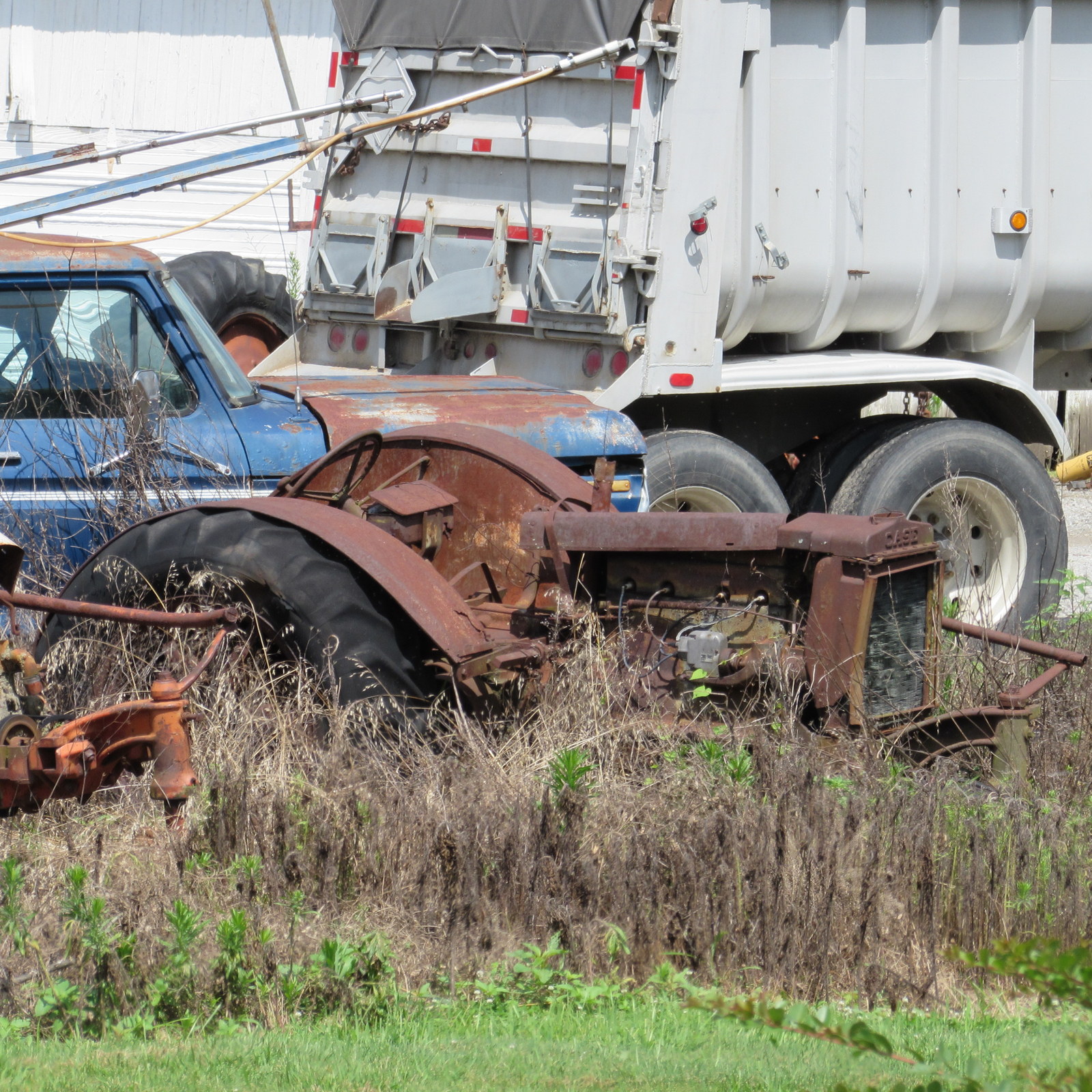
It probably could be, but I think the magneto is worth more than the rest of the tractor. Not quite a basket case, but it might as well be.
Subscribe to:
Posts (Atom)


